
NAPIC Collaborative Programme Funding (CPF) II 

Apply Now: Funding Call Open

National Alternative Protein Innovation Centre NAPIC funding

NAPIC has allocated a pot of £4 million to fund UKRI funding-eligible academic and research organisations to work collaboratively with the alternative protein industry, to facilitate the delivery of a diverse array of innovation challenge-driven projects. This funding will be allocated through several calls until 2028.

Funding Summary

Funding NameCollaborative Programme Funding (CPF) II
Opportunity StatusOpen
Total Fund£4 million (up to £2 million available in this round)
Grant Value Range£5,000 – £100,000
Total Project Value Range£10,000 – £200,000
Opening Date19th Jan 2026 10:00am UK time
Closing Date17th April 2026 16:00pm UK time
Types of Projects

Proof of Concept, Demonstration, Innovation Sprints, Networking Awards, Mobility Awards

NAPIC CPF II: Request for collaboration support


Completing this form enables NAPIC to actively support you by matching your interests and expertise with collaboration opportunities across our network.

The form is for organisations interested in contributing to or collaborating on NAPIC Collaborative Programme Funding (CPF) projects. By outlining the resources you can offer and the support or outcomes you are seeking, we can help identify potential collaboration matches.

If a suitable match is not available immediately, your details will be retained for future opportunities.
Funding Streams

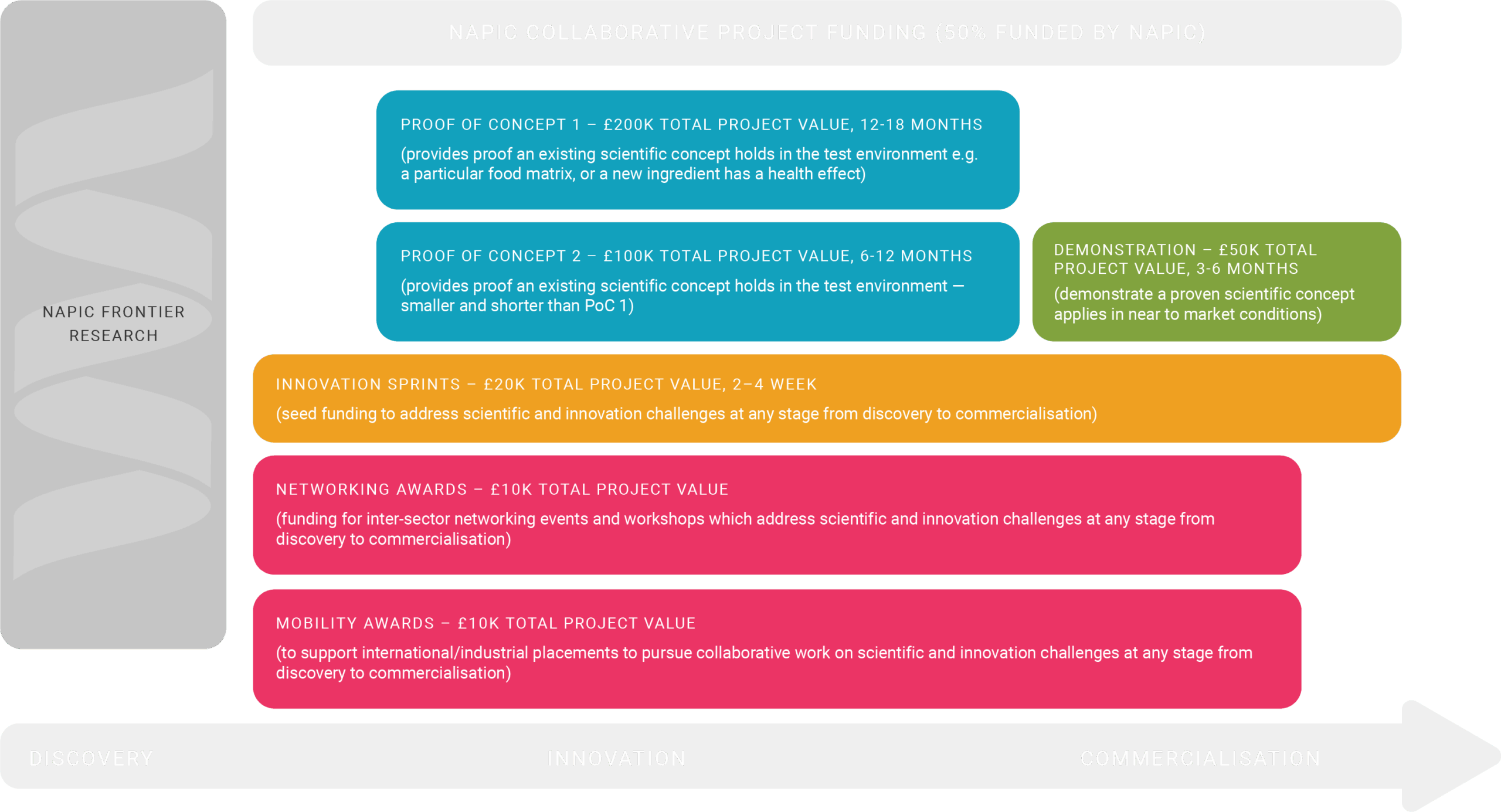
There are six funding streams you will be able to apply for. Please read the guidance available for each stream before starting your application.

NAPIC Funding Streams
PROOF OF CONCEPT 1 AND 2

Funding to support early-to-mid stage commercialisation activities that validate the development of concepts that have arisen from research. There are two tiers of Proof of Concept (PoC) projects - PoC 1 funds larger research and innovation challenges. PoC 2 funds smaller, shorter projects. Projects will be expected to develop a concept, idea or technology from any alternative protein sector which can be in a laboratory, model or real world setting to give confidence for further work.

DEMONSTRATION PROJECTS

Funding will support activities aimed at demonstrating the viability of a new technology, innovation or process to support commercial adoption. This could include development of a prototype, or pilot to demonstrate real life or close to real life working conditions.

INNOVATION SPRINTS

Supports projects focused on fast iteration and testing of ideas within a short timeline. These projects are innovation challenge-driven projects aiming to overcome key technical, regulatory, or market hurdles leading to commercialisation outcomes.

NETWORKING Awards

Funding for inter-sector networking events and workshops which address scientific and innovation challenges at any stage from discovery to commercialisation. We will fund events that bring together academia, industry and/or third sector to share knowledge, identify problems, hold training activities or create dialogue with regulators and policy makers.

MOBILITY AWARDS

Funding to support individuals (especially early career researchers) on international/industrial placements to pursue collaborative work (upskilling, broadening collaborations, etc.) on scientific and innovation challenges at any stage from discovery to commercialisation.

Read the full guidance and apply

How it works

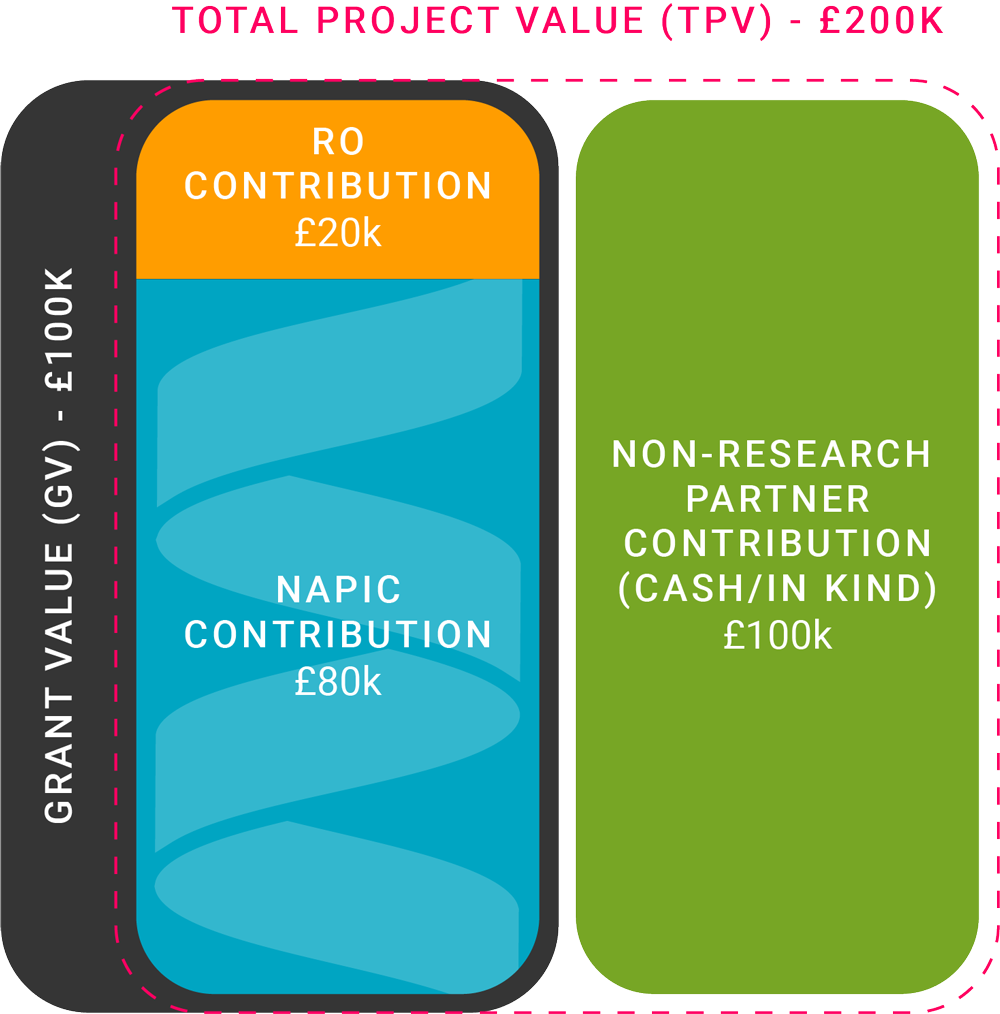
All NAPIC CPF II projects have a total project value (TPV) which is defined by the Research Organisation (RO) and non-research partner contributions.

In addition, all CPF projects have a grant value (GV) which is the total cost to the RO for their portion of the project. 

NAPIC will award 80% of the grant value (GV) directly to the RO. The RO will fund the remaining 20% themselves.

NAPIC does not pay directly to non-research or additional academic partners.

Non-research partner contributions must be equal to, or exceed, the full grant value (GV) of the RO, and can be provided in the form of direct cash or in-kind contribution, depending on the CPF stream. 

An example is provided in the diagram.

Who can be involved

All projects must be collaborative and led by a UK Research Organisation.

For Proof of Concept, Demonstration, Innovation Sprint and Networking Award projects, the project lead must collaborate with at least one non-research partner which must be one of the following UK registered: business of any size, public sector or non-ministerial government department, charity or not for profit.

For a Mobility Award the project lead must collaborate with at least one non-research partner which must be one of the above, or an international research organisation.

Who can apply

All projects must be collaborative and led by a UK Research Organisation.

For Proof of Concept, Demonstration, Innovation Sprint and Networking Award projects, the project lead must collaborate with at least one non-research partner which must be one of the following UK registered: business of any size, public sector or non-ministerial government department, charity or not for profit. There is also the option for additional Research Organisations to be partners.  NAPIC will only pay the Lead Research Organisation

For a Mobility Award the project lead must collaborate with at least one non-research partner which must be one of the above, or an international research organisation.

NAPIC are committed to supporting equality, diversity, and inclusion (EDI) across all our funding activities. We encourage applications from diverse teams and organisations, and expect all applicants to consider EDI in the development and delivery of their proposals.

We welcome applications from across the UK, with particular encouragement for applicants from:

  • Geographical location – Wales and Northern Ireland
  • Research Organisation – Non-core NAPIC co-centre
  • Pillar – People
  • Innovation Challenge – Protein discovery & New metrics and standards
  • Sectors – Feed and service
  • Cross Pillar & Cross Innovation Challenge

Process

  1. Develop idea ensuring your research aligns to one or more of the NAPIC knowledge pillars, sectors, focus areas and address the innovation challenges
  2. Confirm Research partner (grant holder), any additional Research organisations and non-research partner(s) who will provide minimum 50% match funding
  3. Research partner completes and submits application including all requested document uploads
  4. Review process 
  5. Notification of decision 
  6. If successful, Sub-Award letter issued
  7. Project partners develop Collaboration Agreement
  8. Sub-award letter signed
  9. Project delivery commences
  10. Interim report submitted (Proof of Concept projects only)
  11. Final report submitted, including impact monitoring
  12. Ongoing impact monitoring as required

Timeline

What can the funding be used for?

Eligible costs align with UKRI guidelines and include expenses such as investigator/researcher time, consumables, facility costs, and travel and subsistence directly related to project delivery.

Studentships, equipment exceeding £10,000, and publication costs are not eligible for funding.

The University of Leeds, as the grant holder, will allocate funds to successful proposals and reimburse academic partners at 80% of the full economic cost (FEC). Research organisations should itemise invoices based on 100% FEC but will be reimbursed at 80% FEC.

International research organisations can apply for Mobility awards to support collaborative visits, such as a UK postdoc traveling internationally or researchers from outside the UK visiting the UK. However, these funds must be allocated to a UK-based research organisation.

To streamline the post-award process, we have published our template Terms and Conditions.  We strongly encourage Research Organisations to review these during the application phase to minimise delays in the contracting period should your project be successful.

How to apply

Following your feedback, we are reviewing application processes and guidance information. All updates will be released in January 2026.

Please read the guidance for the stream you are applying for before starting your application.

You will need to answer the questions in the application form and provide the following additional documents with your application:

  • Project plan giving an overview of interdependencies, milestones and deliverables. POC only.
  • Letter of support signed by Head of School or Commercial Director
  • Intellectual Property Plan – agreed between research and non-research partners POC only.
  • Declaration of partner contribution – template provided
  • Financial information – template provided 
  • EDI questionnaire


An application template is provided as a Word document within the application form. As the online system does not allow you to save your application, we strongly recommend using this template to prepare your responses in advance.

The template is designed to help you and your project partners structure and develop your application before completing the online submission. Please note that applications must be submitted via the online form — Word documents cannot be submitted directly.

Please ensure that you complete the entire form in one session. Exiting the form before completion will result in the loss of all entered information.

If you require the application form in a different format, please contact us at [email protected]

NAPIC CPF II Webinar – 13th January 2026, 12pm – 1.30pm

Recording available 
This webinar covers the NAPIC Collaborative Programme Funding II scope, eligibility requirements, assessment criteria, and practical guidance on developing strong collaborative proposals, including a case study from CPF Round 1.

CPF 1 Projects

CPF Round 1 has selected pioneering projects from across the UK, covering everything from early-stage discovery to commercial innovation. Together, these initiatives are helping to build a stronger, more sustainable alternative protein sector.

FAQs

Programme Overview
c Expand All C Collapse All

You’ll be asked at application date your intended start date. If you’re going to not meet this, please contact us to discuss possibilities. When selecting your start date consider time needed to obtain any ethics approval and to develop your collaboration agreement.

  1. Unlocking Nature’s Potential – Boosting protein quality and quantity from the complete biome i.e., plants, microbes (fungi, bacteria), insects, food waste, aquaculture (aquatic plants, seaweeds, micro/macroalgae)
  2. Protein Discovery – Identifying important peptides present in traditional proteins that offer the desired functionality, mouthfeel and nutritional benefits and replicating these in APs, through cutting-edge tools
  3. Structuring for Functional and Nutritional Benefits – Structuring APs using colloidal expertise including microgelation, targeted enzymatic fragmentation, creation of cultivated meat, hybrid technologies, and health-led formulation to enhance finished product functionality, whilst improving nutritional value, minimising allergenicity and sensory issues
  4. Enabling Sustainable Bioprocessing at scale – Accelerating industrial AP production, bringing costs down by deriving best practice from fermentation-intensive industries, developing optimisation tools supporting the transition towards continuous processes that improve efficiency and reduce manufacturing footprint
  5. New metrics and standards for product quality and environment – Creating standardised and validated new metrics to quantify technical, nutritional, sensory, quality and safety of APs, objectively
  6. Acceptability and accessibility – Encouraging consumer behavioural shifts across a wide range of age, culture and socioeconomic status towards acceptance of APs including cultivated meat

Perform

Process

Produce

People

More info on our website – https://napic.ac.uk/about/

NAPIC’s collaborative programme funding (CPF) aims to address pent up demand from industry, leveraging the UK’s world-leading academic research and innovation strengths in alternative proteins. CPF funding will be awarded to UKRI eligible research organisations (ROs) to work collaboratively with UK-based non-research partners to accelerate translation of research; overcome technical, regulatory and market hurdles; and solve innovation challenges in the alternative protein (AP) sector.

Visit our website for the latest information about future funding rounds as part of the CPF call – https://napic.ac.uk/funding/

Projects will support the development of innovative solutions to address significant challenges in alternative proteins within the UK AgriFood sector. All projects must relate to alternative proteins. This includes proteins from plants, microbes (fungi, bacteria), insects, food waste, aquaculture (aquatic plants, seaweeds, micro/macroalgae), cultivated meat and dairy, and proteins produced using precision fermentation. Applications can address a range of areas, including food, feed, ingredients, services, equipment and systems development, nutrition, and environmental sustainability.

c Expand All C Collapse All

Yes, networking events can take place outside of the UK, however the eligibility criteria must be met. Please see guidance documents to read the eligibility criteria for each funding stream.

Yes, Any additional Research Organisations (RO’s) will have to share the funding Additional RO’s will also complete the finance document and the letter of support from Head of School Additional RO’s can have Co-Is (there is no requirement for a PI)

No. Studentships or student resource are ineligible costs and may not be requested or included in applications for NAPIC funding.

Yes, you can apply as a PI providing the following conditions are met Your NAPIC project finishes before the end of your current fixed term contract You include a permanent Senior Researcher at your organisation as a co-investigator on your proposal. Your application includes a Letter of Support from your Head of School.

The non-research partner should either be registered in the UK or have a UK research and development or manufacturing site.

All projects must be collaborative. Proof of Concept, Demonstration, Innovation Sprint and Networking Award project proposals must be a collaboration between one UK university/research institution and at least one of the following UK registered: business of any size public sector or non-ministerial government department charity not for profit Mobility Award proposals must be a collaboration between one UK university/research institution and at least one of the following UK registered: business of any size public sector or non-ministerial government department charity not for profit Or: an international research organisation. Funding is only payable to the Research Organisation. Projects must be delivered by UK research organisation eligible for UKRI/BBSRC funding. A full list of eligible organisations can be found here: Research organisations eligible for UKRI funding – UKRI

All projects must have a UK research organisation as the Lead Applicant. They will be the only direct recipient of NAPIC funding.

c Expand All C Collapse All

Yes. If your application is considered not fundable but scores above 50%, you will be invited to re-submit in the next call.

All eligible applications submitted will be subjected to internal or external review (please see Call guidance for more information) followed by consideration for funding by NAPIC’s Funding Evaluation Panel comprising representatives from NAPIC’s Advisory Boards. NAPIC’s Non-Executive Board (NEB) will make the final decision on projects to be funded.

NAPIC will make use of three reviewer pools for CPF; Internal – consisting of the Operational Management Team (Operations Director, Technology & Innovation Manager(s), and Programme Manager) and the two academic Science Management Team (SMT) Champions. External – consisting of the SMT and Industry Advisory Board Steering group. External Plus – consisting of the External pool, in addition to selected experts from wider networks, both national and international. Conflict of interest is managed and reviewers must agree to a Confidentiality Agreement before reviewing any applications. Following review, the Funding Evaluation Panel will make a recommendation to the NAPIC Non-Executive Board of projects for approval. NAPIC reserves the right to apply a ‘portfolio’ approach. The portfolio can be spread across a range of NAPIC: Focus areas Pillars Innovation Challenges Sectors Project durations Locations The ‘portfolio approach’ is used to make sure that funds are allocated across the strategic areas identified in the scope of the funding call. This may mean that a proposal that scores less than yours is successful.

Any individual can only be project lead on 1 application per funding stream, per round. A letter of support from your Head of School must be attached to each application.

No, there is no set template. We suggest you include information covering how you will manage pre-existing intellectual property (IP) or ‘background IP’ being brought to the project, and consideration of how you will generate and manage new ‘foreground IP’. The Lambert Toolkit provides a framework for managing university and business collaboration, available here: University and business collaboration agreements: Lambert Toolkit – GOV.UK

c Expand All C Collapse All

All NAPIC CPF projects have a total project value (TPV) which is defined by as the combined equal contributions of the research organisation and industry contributions to the maximum value stated in each funding stream. In addition, all CPF projects have a grant value which is the amount calculated at 100% full economic cost (FEC) to the research organisation. The FEC model is defined here. The FEC calculated grant value does not include any industry partner contributions and is equal to half the total project value. NAPIC will award the grant value directly to the RO at 80% FEC. The RO will fund the remaining 20% FEC directly. Worked example for PoC 1: Total project value (TPV): £200k Grant Value (GV): £100K NAPIC contribution (paid at 80% FEC): £80k RO contribution (paid at 20% FEC): £20k Industry contribution (cash/in kind): £100k

Non-research partner contributions must be equal to, or exceed, the 100% FEC grant value of the research organisation, and can be provided in the form of direct cash or in-kind contribution, depending on the CPF stream. All contributions must be defined and declared at the application stage. Cash contribution is mandatory for PoC I, equal to, or exceeding, the grant value. A mix of cash and in-kind contribution is required for all other streams.

An in-kind contribution can include Time, Materials, Product, Process, Equipment, Training, Data. Realistic values for in-kind contributions must be declared at application. Please be aware that whilst NAPIC will not require signed timesheets or evidence, BBSRC / Innovate UK reserve the right to audit awardees at any time. Evidence to support time / material / use of equipment will need to be retained and made available upon request for up to 7 years after completion of the CPF project.

Eligible costs include investigator / researcher time, travel and subsistence appropriate to the delivery of the project and consumables. Subcontracting costs are allowed at a maximum of 20% of the total project cost. Subcontractors must be UK-based. Studentships or student resource are ineligible costs and may not be requested or included in applications for NAPIC funding. For further information on eligible costs visit: Directly allocated costs – BBSRC – UKRI Directly incurred costs – BBSRC – UKRI

c Expand All C Collapse All

Notifications of the outcome of applications will be sent to Lead Applicants in July 2026. Feedback will be provided.

All CPF projects are required to report progress, outputs, outcomes and impacts to NAPIC as a condition of the funding. The frequency of reporting required is commensurate with the scale of the funding stream. Mobility, Network, Demonstration, Innovation Sprint and PoC 2 are all required to deliver a final report upon completion of the project. PoC 1 are required to deliver an interim report halfway through the project, in addition to the final project report. Demonstration, Innovation Sprint, PoC 1 & 2 projects must agree to follow up meetings with NAPICs Technology & Innovation Managers post completion of the project to monitor impact that has arisen from the funding. NAPIC will be set up as a funder on ResearchFish, with all CPF projects created as projects therein. All lead-RO will be responsible to report outputs, outcomes and impacts attributed to the CPF funding through this portal for a period of up to 2 years following the project completion.

If you are successful, you will be sent a Conditional Award Letter and asked to sign a Sub-Award letter. In addition, the Research Organisation and Industry partner(s) will also have to create and sign a Collaboration Agreement. Once the Sub-Award letter has been signed a letter will be sent confirming approval to start the project.

Notifications of the outcome of applications will be sent to Lead Applicants. This will include feedback and an invitation for re-submission if scoring above 50%. Applications deemed not fundable, and scoring below 50% will include feedback without an invitation to reapply. Applicants are free to apply in future with a substantially different project into subsequent rounds of the CPF call.

Contact us

If you have any questions, contact [email protected]